

Most affidavits used in courts, government agencies, or official filings need notarization because the document requires a jurat, which is a sworn oath taken in front of a notary. The exception is a federal unsworn declaration under 28 U.S.C. §1746, which some agencies accept instead. Always confirm with the recipient before you sign anything.
TL;DR:
- Ask the recipient whether it requires a jurat, exact certificate wording, exhibit formatting, or a specific form edition; notarization alone does not ensure acceptance.
- For federal matters, an unsworn declaration under penalty of perjury under 28 U.S.C. §1746 may replace notarization, but only if the recipient accepts it.
- Most affidavits need a jurat, which includes an oath or affirmation; an acknowledgment only confirms signing and does not replace that sworn act.
- Bring matching government photo ID and all referenced exhibits, and leave the signature blank until you take the oath before the notary.
- Electronic notarization may be legally valid, but confirm acceptance first, especially for immigration, probate, or litigation filings that may require an in person, wet ink jurat.
Table of Contents
- What notarization actually does for your affidavit
- When notarization is required versus when it’s optional
- Step-by-step: how to get an affidavit notarized
- Jurat versus acknowledgment: which certificate your affidavit needs
- Practical tips for your notarization appointment
- How El Dorado Notary Services supports affidavit notarizations
- How recipient rules control final acceptance of your affidavit
- Common types of affidavits and their notarization requirements
- Legal validity of electronically notarized affidavits
- Why getting the details right matters more than people expect
- Book a mobile notary for your affidavit
- FAQ
- Sources
What notarization actually does for your affidavit
A notary’s job is narrower than most people expect. At a notarization appointment, the notary verifies your identity, confirms you’re signing willingly, and administers an oath or affirmation before witnessing your signature. According to 7 FAM 850, taking an affidavit requires personal appearance, a verbal oath or affirmation, and a signature made in the notary’s presence.
What a notary does not do is check whether your statements are true or legally sound. That responsibility stays with you, the affiant, and it’s why affidavits carry penalty-of-perjury language. The notary’s signature and seal confirm the process was followed correctly, not that the content is accurate.
At a typical appointment, the notary confirms:
- Your identity, using a current government-issued photo ID
- Your willingness to sign without coercion
- Your understanding of the oath or affirmation you’re taking
- That your signature happens in their physical presence
When notarization is required versus when it’s optional
Most state courts and many government agencies require a notarized jurat for affidavits submitted as evidence or supporting documentation. If you’re filing in state court or responding to an agency request, assume notarization is required unless you’re told otherwise.
Federal law offers one notable exception. Under 28 U.S.C. §1746, you can submit a written, unsworn declaration under penalty of perjury instead of a notarized affidavit in many federal matters. Whether a particular court or agency accepts this substitute depends entirely on their own rules, so it’s worth checking before you skip the notary.
Agency-specific instructions can also override general assumptions. The USCIS affidavit of support forms, I-864 and I-864EZ, come with their own signature and edition-date requirements. A few things to verify before you proceed:
- Does the receiving court, agency, or company specifically require a notarized jurat?
- Does the form you’re using have its own signature or edition-date rules?
- Will an unsworn declaration under §1746 satisfy this particular recipient?
Step-by-step: how to get an affidavit notarized
Getting an affidavit notarized correctly takes a bit of preparation, but the appointment itself moves quickly once you’re organized.
- Prepare the document in advance. Type the affidavit, use permanent ink for any handwritten portions, and attach every exhibit referenced in the text.
- Leave your signature blank. Don’t sign until you’re in front of the notary. A jurat requires the signature to happen during the oath, not before.
- Gather your identification. Bring a current government-issued photo ID along with any specific filing instructions from the court or agency receiving the affidavit.
- Appear in person. 7 FAM 850 confirms that personal appearance is required for taking an affidavit; this isn’t a step a notary can skip.
- Take the oath or affirmation. The notary will ask you to swear or affirm that the contents of the affidavit are true.
- Sign in the notary’s presence. This is the moment your signature becomes part of the sworn record.
- Let the notary complete the jurat. They’ll fill out the certificate language, apply their seal, and log the notarization in their journal.
Notarization itself happens on-site in a matter of minutes once you’re prepared. Acceptance by the recipient is a separate matter entirely, so confirm form editions, dates, and signature specifications with the receiving party before your appointment, not after.
Pro Tip: Call the court clerk or agency office a day ahead and ask exactly which notarial certificate they expect; it saves a second trip if the wording is wrong.
Jurat versus acknowledgment: which certificate your affidavit needs
These two notarial acts get confused often, but they serve different purposes. A jurat requires you to take an oath or affirmation and sign in the notary’s presence, which makes it the standard certificate for affidavits. An acknowledgment simply confirms that you appeared and acknowledged signing a document, with no oath involved.
Most affidavits need a jurat because the entire point of an affidavit is a sworn statement.
- A jurat: oath or affirmation, plus signature witnessed by the notary
- An acknowledgment: confirmation that you signed the document, no oath required
- The notary should never choose which act to perform on your behalf
The National Notary Association advises that if the certificate wording on your document is unclear, you should contact the filing authority directly rather than letting the notary guess. Getting this wrong can mean your document gets rejected after the fact.
Practical tips for your notarization appointment
A little preparation prevents most of the delays people run into.
- Bring the complete, unsigned document along with every exhibit it references
- Bring a current government-issued photo ID that matches the name on the affidavit
- Confirm notary fees and any state-specific requirements before the appointment
- Never sign the jurat line ahead of time, even if you’re in a hurry
If you’re dealing with an urgent deadline, a hospitalized relative, or someone in custody who needs a document notarized, a mobile notary service can come to the location instead of requiring travel.
Pro Tip: Keep a folder with your affidavit, exhibits, and ID together before the notary arrives; it cuts the appointment down to just a few minutes.
How El Dorado Notary Services supports affidavit notarizations
We handle mobile jurats, acknowledgments, and power-of-attorney notarizations with 24-hour availability for situations that can’t wait for business hours. A hospital bedside signing or a jail visit often calls for a notary who travels to you rather than a walk-in counter with fixed hours. For routine paperwork with no time pressure, a local walk-in service might be simpler, but when timing or location gets complicated, a mobile appointment keeps things moving.
Written by Nick for El Dorado Notary Services.
How recipient rules control final acceptance of your affidavit
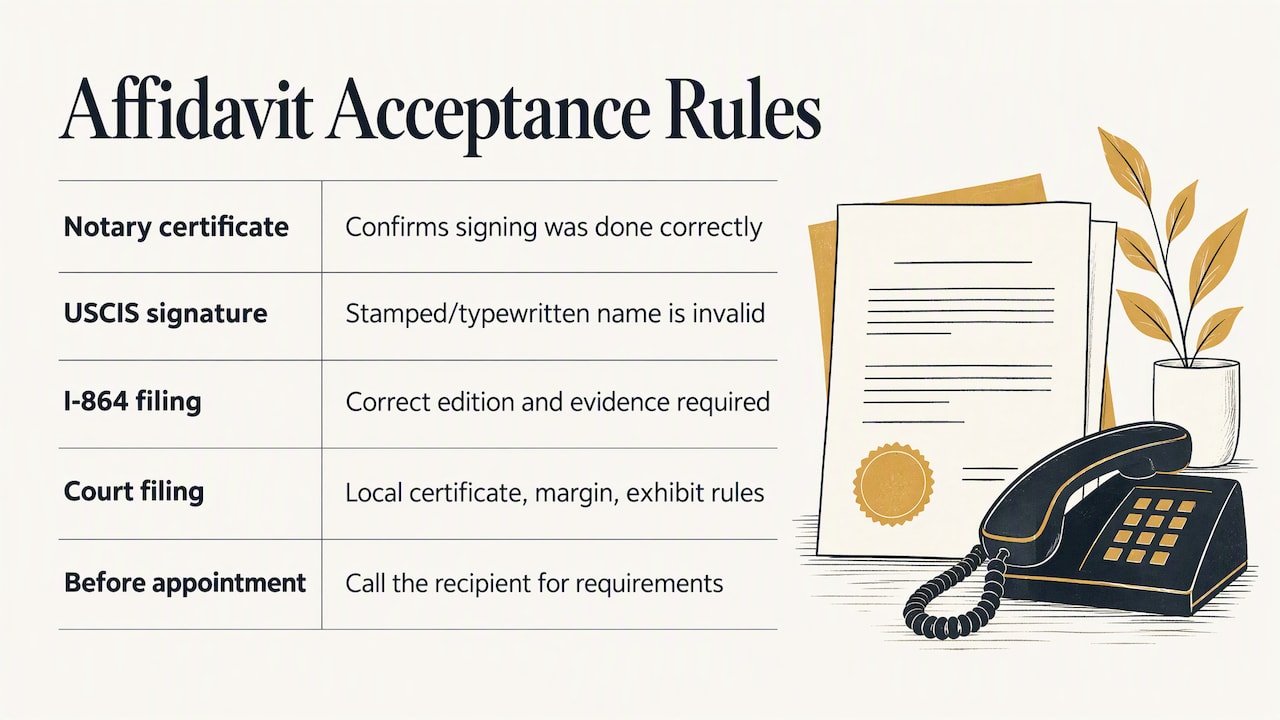
Notarization and acceptance are two separate steps, and mixing them up is where most delays happen. A notary can complete a flawless jurat, but if the receiving court, agency, or company has its own formatting rules, a technically valid notarization can still get rejected.
The USCIS instructions for Form I-864 make this distinction clear: a stamped or typewritten name doesn’t count as a valid signature, and a form filled out on the wrong edition or missing required evidence can be sent back regardless of how properly it was notarized. The agency controls acceptance criteria independent of what the notary does.
Courts work the same way. Local rules sometimes specify exact certificate language, margin requirements, or exhibit formatting that has nothing to do with notarization but everything to do with whether the clerk accepts your filing. Before your appointment, it’s worth calling the specific court department, agency office, or company requesting the affidavit and asking directly what they need. This single phone call resolves more rejected affidavits than any amount of careful notarizing ever will, because the notary’s certificate confirms the signing was done correctly, not that the paperwork meets a particular recipient’s internal standards.
Common types of affidavits and their notarization requirements
Affidavits show up across a wide variety of legal and personal situations, and the notarization expectations shift depending on the type.
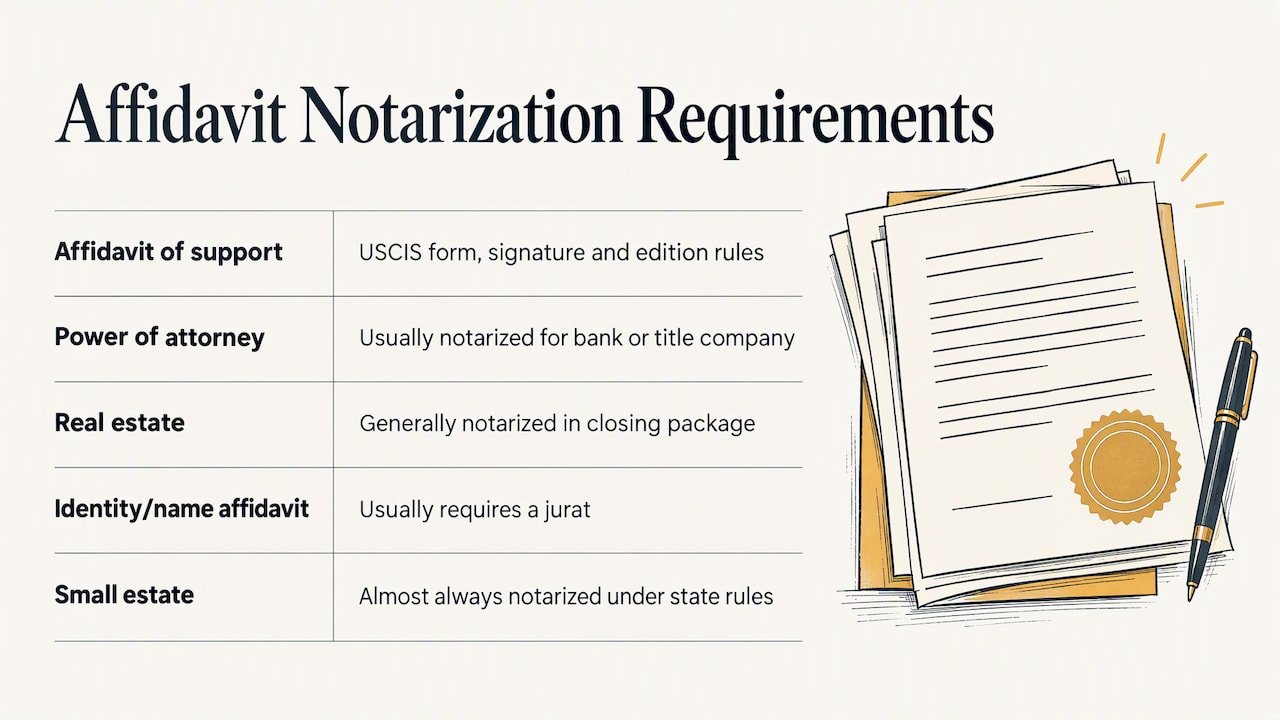
An affidavit of support, used in immigration sponsorship cases, follows specific USCIS form instructions on the I-864/I-864EZ forms, including signature and edition-date rules that go beyond a standard jurat. A power of attorney affidavit often accompanies real estate or financial transactions and typically requires notarization before a title company or bank will honor it; our power of attorney notarizations handle this directly.
A real estate affidavit, such as an affidavit of title or occupancy, generally needs notarization as part of a closing package, often alongside other signed documents in a loan signing. An affidavit of identity or name change affidavit usually requires a jurat since the signer is swearing to specific facts under oath. A small estate affidavit, used to transfer property without full probate, almost always requires notarization under state court rules.
Each type carries its own formatting quirks, so matching the certificate language and attached exhibits to what the recipient expects matters as much as the notarization itself.
Legal validity of electronically notarized affidavits
Remote online notarization has expanded in recent years, and many states, including California, permit some form of electronic or remote notarization under specific conditions. Whether a court or agency will accept an electronically notarized affidavit is a separate question from whether the notarization itself was legally performed.
Some federal agencies and state courts have been slower to accept electronic notarizations for sworn affidavits, particularly in matters involving immigration, probate, or litigation, where original wet-ink signatures or in-person jurats are sometimes still expected. Our recent breakdown of California notary rule changes covers how state requirements have shifted and where gaps remain between what’s legally valid and what a given recipient will actually accept.
The safest approach is the same one that applies to in-person notarization: confirm with the specific court, agency, or company whether they accept electronic notarization before you rely on it for an affidavit with real legal consequences. A traditional in-person jurat remains the most universally accepted format, which is part of why mobile notary appointments, where a notary travels to you for a standard wet-signature jurat, continue to be the more reliable choice for affidavits tied to court filings or immigration matters.
Why getting the details right matters more than people expect
The single biggest mistake we see with affidavits isn’t the notarization itself, it’s signers assuming one certificate type or one set of rules applies everywhere. A jurat completed perfectly for a probate court can still get rejected by an agency that wanted different language. Checking recipient instructions before the appointment, not after, is the habit that actually prevents delays.
— Nick
Book a mobile notary for your affidavit
When your affidavit needs a jurat, an acknowledgment, or a power-of-attorney signature, we bring the appointment to you, with 24-hour availability for hospital visits, jail signings, or deadlines that can’t wait.

- Mobile jurats and acknowledgments at your home, office, or care facility
- Power of attorney and trust document notarizations
- Loan signing and real estate closing support
- 24-hour availability for urgent situations
Visit our services page to see what we cover, or head to El Dorado Notary Services to check availability and book an appointment.
FAQ
What documents must be notarized?
Documents that typically require notarization include affidavits submitted to courts, power of attorney forms, real estate deeds, loan documents, and certain affidavits of support like USCIS Form I-864. The specific requirement depends on the court, agency, or institution requesting the document, so it’s worth confirming directly with them.
How much does UPS charge to notarize a document?
Notary fees at retail locations like UPS Store franchises vary by location and are set independently by each store, so there’s no single published rate. We recommend calling the specific location directly or checking with a dedicated notary service for a clear, upfront quote on cost before your appointment, as fees vary by location and type of service.
How do I write a notarized affidavit?
A properly prepared affidavit is typed, includes all referenced exhibits, and leaves the signature line blank until you’re in front of the notary. The notary then administers an oath or affirmation, witnesses your signature, and completes the jurat certificate, as outlined in 7 FAM 850.
How much is the notary fee?
Notary fees vary by state and by the type of notarial act performed, with some states setting maximum allowable fees by statute. Mobile notary services may also charge a separate travel fee on top of the notarization fee, so it’s best to confirm pricing details directly with the notary before booking.
Sources
- 7 FAM 850 TAKING AN AFFIDAVIT
- Affidavit of Support Under Section 213A of the INA | USCIS
- How to notarize an affidavit | National Notary Association