
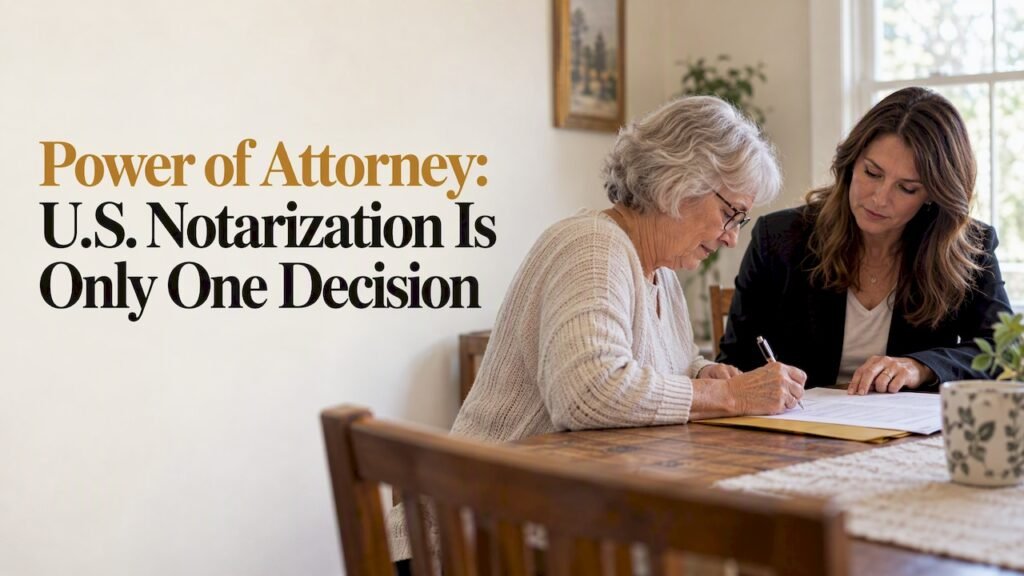
Whether your power of attorney needs notarization depends on your state, the type of POA you’re signing, and who will accept it. Many states require a notarized acknowledgment, and some add witness requirements on top of that. Before you sign anything, confirm your state’s rule and check what the receiving bank, title company, or foreign authority will actually accept. Your options include a local notary, a mobile notary, a U.S. consulate abroad, or remote online notarization where it’s authorized.
TL;DR:
- Florida and New York require two witnesses in addition to notarization for covered powers of attorney; some states also require statutory notices or specific forms.
- Banks may demand a notarized original, while title companies can require wet ink signatures or statutory forms; some institutions reject older powers of attorney.
- For signers abroad, confirm the notary’s state and destination country permit remote notarization and the recipient accepts it; otherwise, use in person notarization.
- For overseas use, execution comes first: Hague Convention destinations generally require an apostille, while nonmember countries need an authentication certificate; consular seals cost about $50.
Table of Contents
- Why notarization matters for a valid power of attorney
- How to check your state’s power of attorney rules
- Remote online notarization: what it covers and where it falls short
- Using a notarized power of attorney outside the United States
- Getting your power of attorney notarized: a practical checklist
- When a mobile notary makes the difference for a power of attorney
- Getting it right the first time matters more than speed
- How El Dorado Notary Services supports your power of attorney signing
- FAQ
- Sources
Why notarization matters for a valid power of attorney
Notarization exists to confirm that the person signing the power of attorney is who they claim to be, and that they signed willingly. When a notary witnesses your signature and attaches an acknowledgment, that acknowledgment carries legal weight if anyone later questions whether the document is genuine.
The Uniform Power of Attorney Act builds this presumption directly into its model language: when a signature is acknowledged before a notary, the law presumes it genuine. That single presumption is often what keeps a POA from being challenged by a bank, a family member, or a court. The same model act also addresses portability, meaning a POA properly executed in one state should generally be recognized in another. That portability provision is useful context, but it’s a model act, not federal law. The state where you actually need the POA to work has its own statute, and that statute controls.
This is where things get practical rather than theoretical. Even when your state’s law doesn’t strictly require notarization for a particular POA, the people you hand it to often do:
- Banks frequently insist on a notarized original before honoring a financial power of attorney.
- Title companies and county recorders may require a specific statutory form or an original wet-ink signature, not a copy.
- Some institutions won’t accept a POA that’s more than a few years old, regardless of how it was executed.
So you’re really managing two separate questions at once: what your state’s statute requires, and what the recipient will actually accept. Satisfying one without checking the other is how people end up re-executing a document they thought was finished.
How to check your state’s power of attorney rules
There’s no shortcut around confirming your own state’s requirements, because the rules genuinely differ enough to matter. The most reliable path is to search your state legislature’s website or your secretary of state’s notary division page using terms like “power of attorney” combined with “notary” or “witness requirements.” Look for the actual statute citation rather than a summary, since summaries sometimes blend requirements from different states.
Across the states, execution rules tend to fall into a few recognizable patterns:
- Notarization only, with no separate witness requirement for most general POAs.
- Notarization plus one or two witnesses, which is common for durable or health care powers of attorney.
- A required statutory notice or specific form language that must appear in the document itself, separate from the notarization step.
A few concrete examples show how much this varies. Florida law, under Florida Statutes §709.2105, requires two subscribing witnesses in addition to notarized acknowledgment for covered powers of attorney, one of the stricter combinations in the country. New York similarly requires two witnesses alongside acknowledgment, and under its General Obligations Law, the notary taking the acknowledgment may also serve as one of those witnesses. Pennsylvania has its own witness provisions that differ in detail from both. California, where our team is based, has specific notes around filing or recording requirements for certain POA-related documents, particularly those tied to real estate.
If you’re in California and want a clear picture of what’s changed recently, our California notary regulations update for 2025 walks through the adjustments that affect how documents like these get executed in the state. Reading your actual state statute, rather than relying on a general guide, is the only way to be certain which category your POA falls into.
Remote online notarization: what it covers and where it falls short
Remote online notarization, usually shortened to RON, lets a signer complete the process over live audio and video instead of sitting across a table from a notary. The notary verifies identity through knowledge-based questions or credential checks, witnesses the signing on screen, and attaches an electronic notarial certificate. Many states have passed laws authorizing RON, but authorization isn’t uniform nationwide, and the details of what counts as proper identity verification differ from state to state.
Two checks matter more than anything else before you rely on RON for a power of attorney:
- The notary’s commissioning state must legally authorize RON for a signer who is physically located where you are, including signers outside the United States.
- The institution or authority that will ultimately accept the POA, whether a bank, title company, or foreign government office, must be willing to accept a remotely notarized document rather than insisting on an in-person original.
Signers located outside the United States face the sharpest version of this problem. According to State Department guidance on notarial services abroad, cross-border remote notarization isn’t automatically valid just because the notary’s home state permits RON. You need to verify the commissioning state’s law, the rules of the foreign country where you’re physically present, and whether the receiving institution will accept the result. Skipping any one of those checks is how a signer ends up with a document nobody will honor.
RON is worth avoiding altogether when the destination country or the receiving institution explicitly requires a wet-ink original or a specific consular legalization step. In those cases, an in-person notarization, whether local or through a U.S. consulate, is the safer route from the start.
Pro Tip: Before scheduling a RON session, get written confirmation from the receiving bank, title company, or foreign office that they’ll accept a remotely notarized power of attorney. A quick email now avoids re-executing the document later.
Using a notarized power of attorney outside the United States
A power of attorney headed overseas needs to clear two separate stages, and conflating them is one of the most common mistakes signers make. The first stage is proper execution: notarization, plus any witnesses your state requires. The second stage is authentication for the destination country, and that step depends entirely on where the document is going.
- Confirm execution first. Make sure the POA is notarized and witnessed exactly as your state’s law requires before you move on to authentication. Skipping ahead can invalidate later steps.
- Determine whether the destination country is part of the Hague Convention. If it is, you’ll need an apostille. The Office of Authentications at the U.S. Department of State issues apostilles for federal-level documents and authentication certificates for countries outside the Hague Convention, and state-level offices typically handle state-issued documents first.
- If no U.S. notary is available where you’re located, visit a U.S. embassy or consulate. Consular officers provide in-person notarial services, but personal appearance is required. According to the State Department’s guidance on overseas notarial services, these offices don’t offer remote notarization, may require witnesses depending on the document, and charge roughly $50 per consular seal. Signers are also instructed not to sign the document before the actual appointment.
- Check whether the destination authority needs anything beyond authentication, such as a certified translation or a specific form. An apostille or authentication certificate confirms the notary’s authority. It doesn’t replace an underlying execution requirement like witness signatures.
Getting your power of attorney notarized: a practical checklist
Once you know your state’s rule and your recipient’s requirements, the actual notarization process is straightforward if you prepare in the right order.
- Finalize the POA text using an attorney-drafted document or your state’s statutory template, since using the wrong form is a common source of rejection.
- Confirm which state’s law governs the document and what the receiving institution specifically requires, in writing if possible.
- Decide how you’ll get it notarized: a local notary office, a mobile notary who comes to you, a U.S. consulate if you’re abroad, or RON if every jurisdictional check clears.
- Gather your identification, line up witnesses if your state requires them, and confirm any forms the recipient wants alongside the notarized POA.
- If the document is headed overseas, build in time for apostille or authentication processing before you need the final version.
What to bring to the appointment itself is simple but easy to forget under pressure:
- A valid, unexpired photo ID, typically a driver’s license or passport.
- The unsigned original power of attorney, since most notaries require you to sign in their presence.
- Witness identification, if your state’s statute requires witnesses.
- Any specific form or cover sheet the receiving institution has asked for.
Costs vary by path. State notary fees for a standard acknowledgment are often modest, mobile notary appointments add a travel or convenience fee on top of that, consular notarizations run about $50 per seal, and apostille processing through the Department of State takes additional time you should plan around rather than discover at the last minute.
When a mobile notary makes the difference for a power of attorney
Some power of attorney signings don’t fit neatly into a trip to a notary’s office, and that’s exactly where a mobile notary earns its place. Our mobile notary team is led by a certified signing agent, and we handle power of attorney documents alongside loan signings, real estate closings, and urgent notarizations at hospitals or jails. If a family member is hospitalized and needs a POA executed before a procedure, or a signer simply can’t travel, we come to the location instead of asking them to come to us.

Before an appointment, we ask clients to have the unsigned document ready, bring valid photo identification, and arrange for witnesses in advance if the document requires them. That preparation keeps the signing itself quick, which matters most when timing is tight. You can see the full scope of what we cover on our power of attorney service page for El Dorado County.
Getting it right the first time matters more than speed
The biggest risk in power of attorney notarization isn’t missing a signature, it’s assuming one path will satisfy everyone who touches the document later. A POA that clears your state’s statute can still bounce at a bank that insists on specific language, or at a foreign registry that wants an apostille you never obtained.
If certainty matters more than convenience, in-person notarization followed by the correct authentication chain for your destination is the most dependable route. Use remote online notarization only when the notary’s commissioning state, your physical location, and the receiving institution all explicitly accept it, not when two out of three line up. And always confirm the recipient’s exact requirements before you sign anything, because re-executing a power of attorney costs far more time than checking first ever would.
— Nick
How El Dorado Notary Services supports your power of attorney signing
Getting a power of attorney notarized correctly the first time saves you from re-executing a document under pressure later, and that’s exactly the problem our mobile service is built to solve. We bring notarization to your location, with 24-hour availability for the signings that can’t wait, including hospital and jail visits.

Before booking, have your unsigned POA ready, your photo ID on hand, and any required witnesses arranged. From there, we handle the rest:
- Mobile power of attorney notarization at your home, office, or care facility.
- Support for loan signings and real estate closings when a POA is part of a larger transaction.
- Flexible scheduling built around urgent or time-sensitive situations.
Visit our power of attorney page to check availability or book an appointment directly.
This article is general information, not a substitute for advice from a qualified lawyer. Consult a qualified legal professional about your own circumstances before acting on anything here.
FAQ
Can a power of attorney be used internationally?
Yes, but it usually needs an added authentication step before a foreign authority will accept it. A POA executed in the United States typically requires an apostille for Hague Convention countries, or an authentication certificate for non-Hague countries, both issued through the Department of State’s Office of Authentications.
Can a POA be notarized in a different state from where it will be used?
Generally yes, since the Uniform Power of Attorney Act includes portability provisions meant to help a properly executed POA travel across state lines. That said, the model act’s portability language only applies to the extent the destination state has actually enacted it, so checking that state’s statute is still worthwhile.
What are common POA mistakes to avoid?
The most frequent mistakes are skipping required witnesses, using an outdated or wrong statutory form, and assuming notarization alone will satisfy every recipient. Notary best practices recommend verifying signer identity and capacity, logging the notarization in a journal, and confirming recipient acceptance before the signing takes place, not after.
How much do notaries charge to notarize a power of attorney?
State notary fees for a standard acknowledgment tend to be modest, while a mobile notary adds a travel or convenience fee for coming to your location. If the signing happens at a U.S. embassy or consulate abroad, expect a consular seal fee of about $50 per seal.
Sources
- Notarial and Authentication Services at U.S. Embassies and Consulates
- Uniform Power of Attorney Act (model act text)
- How to handle a power of attorney notarization (Notary Public Association guide)