

A mobile notary is a commissioned notary public who travels to meet you at a location you choose, rather than asking you to visit an office, to witness signatures and complete official notarizations in person. Fees, allowed travel charges, and some procedural rules vary from state to state, so the exact cost and process can shift depending on where you live.
TL;DR:
- State law sets the fee for each notarial act, while the notary may add travel charges; caps and travel rules vary by state.
- For loan closings, confirm whether you need a trained Notary Signing Agent; title or escrow companies usually pay agents, who handle stricter loan procedures.
- Remote online notarization can suit routine documents when speed matters, but it is available only where state law permits it and uses live video identity checks.
- Leave documents unsigned and bring current government photo ID; signing ahead can invalidate the notarization and require a repeat appointment.
- Choose mobile service when illness, hospital or jail visits, or tight closing deadlines make office travel impractical; an in office appointment may cost less.
Table of Contents
- How a mobile notary works and what happens at your appointment
- Mobile notary vs. regular notary vs. online notary vs. signing agent
- What services do mobile notaries commonly handle?
- How much does a mobile notary cost?
- When should you actually hire a mobile notary?
- How to find and hire a mobile notary
- A real-world look at how mobile notary services are structured
- What matters most when choosing a mobile notary
- How El Dorado Notary Services can help
- FAQ
- Sources
How a mobile notary works and what happens at your appointment
A mobile notary holds the same state notary commission as any other notary, and that commission is what gives them legal authority to witness document signings. The notarial acts they perform are typically the same ones you’d get at a bank or office: acknowledgments (confirming you signed a document willingly), jurats (administering an oath before you sign), and oaths or affirmations for sworn statements.
The appointment itself follows a fairly predictable sequence, whether you’re signing a power of attorney at your kitchen table or closing on a house:
- You schedule a time and location, often the same day or next day depending on availability.
- The notary arrives at the agreed location, whether that’s a home, office, hospital room, or coffee shop.
- They check your government-issued photo ID to confirm your identity matches the name on the documents.
- They watch you sign (or re-sign if needed) and confirm you understand what you’re signing and are doing so willingly.
- They complete their notary journal entry, apply their official seal and signature, and hand back your completed documents.
The logistical difference from an in-office notarization is really just the location. A bank or shipping-store notary makes you come to them during business hours, while a mobile notary builds the schedule around your availability, including evenings, weekends, or urgent situations where getting to an office simply isn’t realistic.
Mobile notary vs. regular notary vs. online notary vs. signing agent
Once you understand the basic definition, the next question is usually which type of notary fits your situation. Four options tend to come up, and each solves a different problem.
- In-office notary: You travel to a bank, shipping store, or law office during set business hours, and the notarization happens at their desk.
- Mobile notary: The notary travels to you, which trades a small travel fee for flexibility on location and timing.
- Remote online notary (RON): The entire notarization happens over live video, with identity verified through knowledge-based questions or ID scanning technology rather than an in-person check, and some providers offer this around the clock in states that permit it.
- Notary Signing Agent (NSA): A notary with extra training specifically for loan documents, who typically works loan closings for title or escrow companies rather than being hired directly by the signer.
The distinction between a mobile notary and a Notary Signing Agent matters more than it might seem. NSAs handle specialized loan-document packages, often complete additional training or background screening, and are usually paid by the title company or signing service rather than by the individual signer. A general mobile notary, by contrast, typically notarizes whatever documents you already have ready and is paid directly by you.
Pro Tip: If you’re closing on a loan, confirm whether you need a general mobile notary or a trained Notary Signing Agent, since the paperwork and procedures for loan packages are stricter than for a simple acknowledgment.
In-person mobile notarization tends to make the most sense when you need a document witnessed quickly or when travel is difficult. Online notarization fits routine documents when speed matters more than a face-to-face visit, and it depends on your state permitting it.
What services do mobile notaries commonly handle?
Mobile notaries handle a wide variety of documents, and the common thread is that each one legally requires a notary’s witness and seal before it holds up. Here’s what typically crosses a mobile notary’s desk:
- Powers of attorney, which let someone else make financial or medical decisions on your behalf.
- Healthcare directives and advance directives, often needed quickly for aging or ill family members.
- Trust documents, including amendments and certifications of trust.
- Acknowledgments and jurats for general business or personal paperwork, from affidavits to consent forms.
- Real estate and loan signings, though these often call for a Notary Signing Agent given the additional training and document handling involved.
Location flexibility is part of what makes mobile service useful in the first place. Mobile notaries routinely travel to homes, hospitals, jails, workplaces, and senior living facilities, and many work outside standard business hours for signers who can’t wait until Monday morning. Some also offer ancillary services like printing documents on the spot or acting as a courier to return signed paperwork to a title company, which can save you a separate trip entirely.
How much does a mobile notary cost?
Mobile notary pricing has two distinct pieces, and understanding the difference keeps you from being surprised by the final bill. The first is the statutory notarization fee, a per-signature amount that many states cap by law. The second is a separate travel or service fee that the notary charges to come to you, and this part may not be capped or may vary by state.
- Statutory fee: Set by state law and charged per notarial act, such as the statutory notarization fee in California is set by state law.
- Travel fee: Charged on top of the statutory fee, structured as mileage, a flat trip charge, or folded into one bundled service price.
- Disclosure: A reputable mobile notary tells you the total cost, including travel, before the appointment, not after.
State rules on this vary more than people expect. Some states have low statutory notarization fees but still allow reimbursement for travel expenses, varying by jurisdiction, which means two notaries in different states can legally charge very different totals for the same document. Because these caps and allowances differ by state, it’s worth checking your own state’s notary office or statute before booking if you want to confirm the exact limit.
Many mobile notaries also bundle travel with other fee-based services like after-hours availability or printing, and the better operators itemize these on your receipt so you can see exactly what you paid for.
When should you actually hire a mobile notary?
A mobile notary earns its convenience fee in specific situations, and recognizing them makes the decision easier.
- Mobility limitations: If driving to an office is difficult due to age, injury, or illness, having the notary come to you removes that barrier entirely.
- Urgent or location-locked signings: Hospital bedsides and jail visits are common examples where the signer simply cannot leave to find a notary.
- Multiple signers in different places: Mobile notaries can sometimes coordinate separate visits so everyone signs without needing to be in the same room.
- Time-sensitive closings: Real estate deals and loan documents often have strict deadlines that a flexible, after-hours appointment can help you meet.
Weigh accessibility and timing against cost sensitivity. If you can easily get to a bank branch during business hours, the convenience of mobile service may not be worth the added travel fee. If getting there is the actual problem, that fee buys back time and stress that’s hard to put a price on.
How to find and hire a mobile notary
Finding a mobile notary isn’t complicated, but a little preparation makes the appointment faster for everyone.
- Search local listings or professional directories for notaries who explicitly advertise mobile or traveling service.
- Check direct service pages from local notary businesses, which usually list service areas and typical response times.
- Ask about fees upfront, including the statutory charge, travel fee, and whether they handle after-hours or hospital and jail visits.
- Confirm what ID you need before the appointment, since most states require a current government-issued photo ID.
Pro Tip: Have your documents filled out (but not signed) and your photo ID ready before the notary arrives, since signing in advance can invalidate the notarization and require a redo.
Once booked, the notary will verify your identity, watch you sign, and complete the journal entry and seal on site, usually within fifteen to twenty minutes for straightforward documents.
A real-world look at how mobile notary services are structured
El Dorado Notary Services offers a useful illustration of how a mobile notary business organizes its offerings around the situations covered above. The lineup includes loan signing agent work, real estate closings, power of attorney notarizations, trust documents, acknowledgments and jurats, and hospital or jail appointments, with 24-hour availability for urgent needs.
Service pages lay out what’s offered and how booking works, which reflects the kind of upfront fee and availability disclosure described earlier in this guide. This is one example of how a mobile notary can structure availability and transparency, not the only model you’ll find, but it shows the pattern worth looking for wherever you hire.
What matters most when choosing a mobile notary
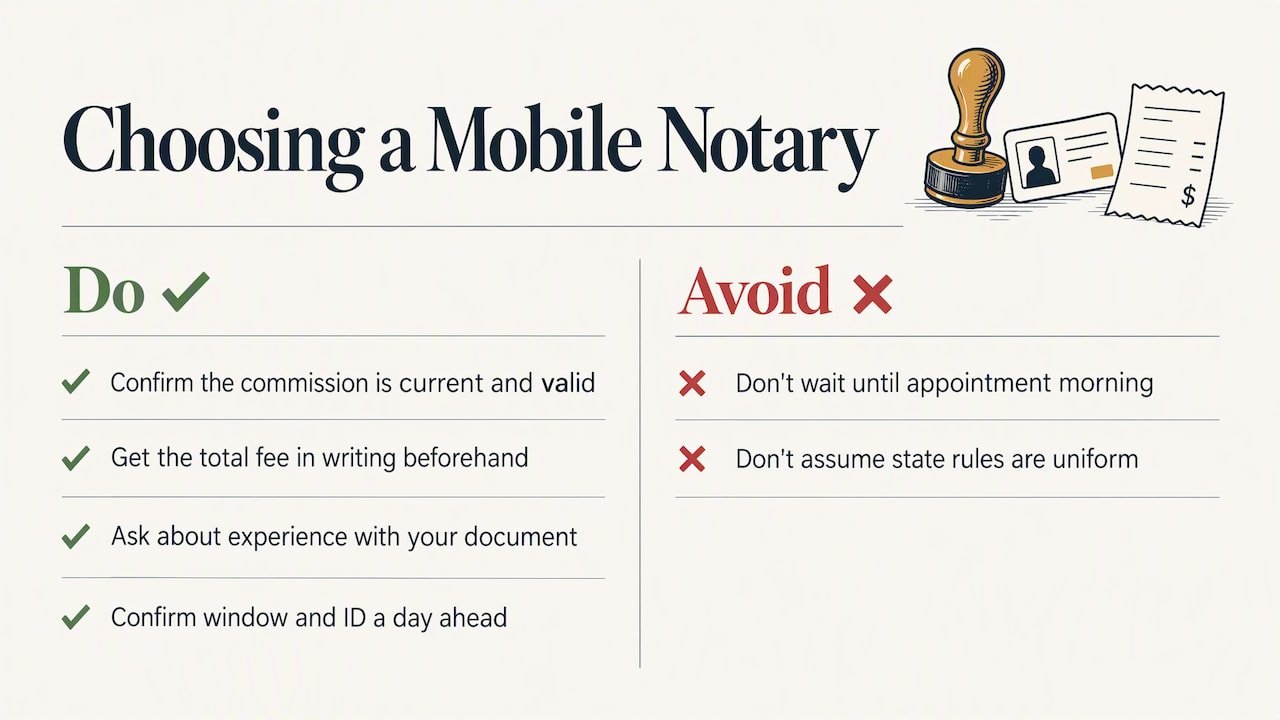
If I had to boil this down to a short checklist, it would be: confirm the commission is current and valid in your state, get the total fee in writing before the appointment, and ask whether the notary has handled your specific document type before. A power of attorney for an aging parent and a loan package for a refinance are not the same job, and experience with the right one matters.
One habit worth adopting: confirm your exact arrival window and which photo ID you’ll have on hand a day ahead, not the morning of. It avoids the awkward moment of a notary arriving to find the wrong ID or no ID at all. And because fee caps and procedural rules differ by state, a quick check of your state’s specific guidance never hurts before you book.
— Nick
How El Dorado Notary Services can help
We built our mobile notary service around the exact friction points covered in this guide: unclear fees, limited hours, and documents that can’t wait for a weekday office visit. We handle a full range of mobile notarization work with flexible availability for urgent situations that regular business hours can’t accommodate.

What we offer:
- Loan signing services
- Real estate closing notarizations
- Power of attorney notarizations
- Trust document notarizations
- Acknowledgments and jurats for business and personal documents
- Hospital and jail notary visits
- General business and personal document notarizations
We quote total costs before we arrive, so there’s no guessing about travel or service charges once the appointment starts. Visit our mobile notary services page to check availability and book an appointment that fits your schedule.
FAQ
What is the difference between a mobile notary and a regular notary?
Both hold the same state notary commission and perform the same notarial acts, but a mobile notary travels to your location while a regular, in-office notary requires you to come to them. The practical difference is convenience and typically a travel or service fee added to the standard notarization charge.
How do mobile notaries get paid?
Mobile notaries charge a statutory per-signature fee set by state law, plus a separate travel or service fee for coming to your location. Notary Signing Agents working loan closings are usually paid by the title or escrow company rather than by the individual signer, which differs from how most general mobile notaries are compensated.
Why would someone need a mobile notary?
People hire mobile notaries when travel to an office isn’t practical, such as mobility limitations, hospital or jail visits, or time-sensitive closings that require after-hours scheduling. Multiple signers in separate locations also benefit, since a mobile notary can sometimes coordinate separate visits instead of requiring everyone in one room.
Is it difficult to become a mobile notary?
Becoming a mobile notary starts with meeting your state’s standard notary commission requirements, then adding the logistics of travel and scheduling to serve clients at their chosen location. Notaries who want to specialize in loan closings as Notary Signing Agents typically need additional training or background screening on top of the base commission.